OMER SIMEON - A HOT CLARINET IS GOOD TO FIND
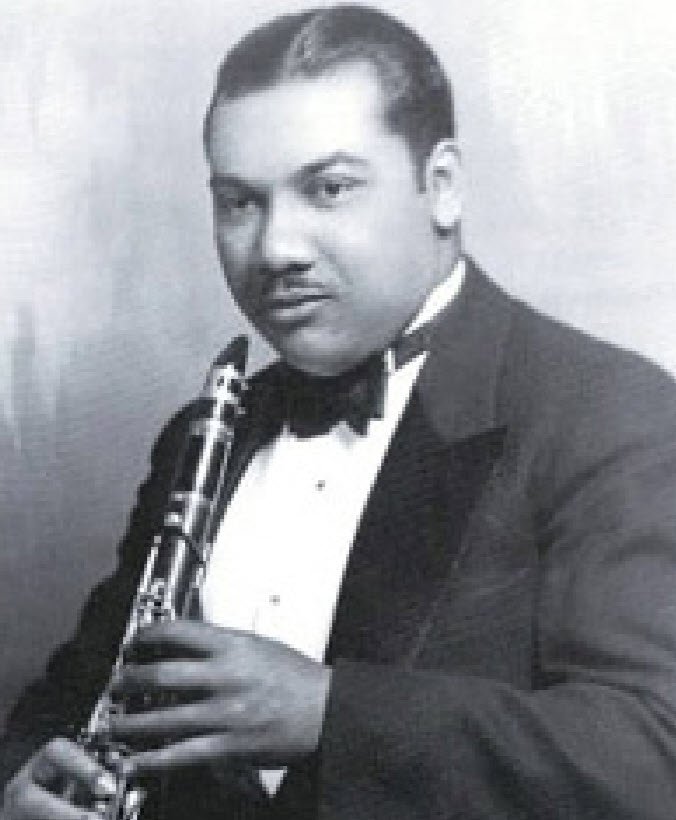
This is one more in a series of biographies of great traditional jazz musicians. The series started with the March/April 1991 issue and was developed by Rambler founding publisher and Board Member, the late Len Levine
iN OUR FINAL 2012 SESSION DECEMBER 16
AUTHOR: By Hal Smith
Originally Posted Dec 2012
In the late 1950s, Mary Russell presented her husband Pee Wee with an LP reissue of Jelly Roll Morton’s 1926 Red Hot Peppers recordings. Pee Wee was fascinated by Omer Simeon’s clarinet work on the records and played the sides over and over.Soon after, he went to hear Simeon with the Wilbur DeParis band at a New York nightclub. Pee Wee was so overcome that he marched up to the bandstand and hugged Omer Simeon! After listening to Simeon’s haunting and somewhat quirky solo on Morton’s recording of “Smoke House Blues” it is easy to understand why Pee Wee reacted that way. They were definitely kindred spirits of the clarinet.
Omer Simeon was born in New Orleans in 1902. His family moved to Chicago in 1914, where he studied clarinet with Lorenzo Tio, Jr. -- who also counted Johnny Dodds, Jimmie Noone, Sidney Bechet, Barney Bigard and Albert Nicholas among his pupils!
Simeon became an in-demand reedman who also played alto, soprano and baritone saxophones. He was working with Elgar’s Creole Orchestra when bandleader Jelly Roll Morton summoned him to participate in the Red Hot Peppers recording sessions for RCA Victor. Simeon was clearly inspired by the playing of Morton, cornetist George Mitchell, trombonist Kid Ory, banjoist/ guitarist Johnny St. Cyr, bassist John Lindsay and drummer Andrew Hillaire. If Omer Simeon never made another record, the sides with Morton are eloquent testimonies to his genius as a clarinetist. Simeon’s ensemble work is flawless and every one of his solos is a masterpiece. The Tio influence is evident in Simeon’s Dodds-like chorus on “Original Jelly Roll Blues” and “The Chant” which resembles Jimmie Noone’s agile style. The solo on “Black Bottom Stomp” has elements of Tio and his students, but is unmistakably Simeon. The aforementioned “Smoke House Blues” ventures into the type of sounds that would be heard a few months later in 1926, when a 17-year-old Chicagoan played an “outside” solo on Ben Pollack’s recording of “Deed I Do.”
Throughout the mid-to-late ‘20s, Omer Simeon continued to work with the Elgar Orchestra and also with Erskine Tate’s Orchestra. He recorded with King Oliver’s Dixie Syncopators, Jabbo Smith, the Dixie Rhythm Kings and Reuben Reeves. Jelly Roll Morton once called Omer Simeon his “favorite clarinetist,” so it is no surprise that Simeon was included on the 1928 Red Hot Peppers date that produced another set of classics: “Shreveport Stomp,” “Mournful Serenade,” “Boogaboo,” “Kansas City Stomp,” “Shoe Shiner’s Drag” and “Georgia Swing.” As on the previous Morton recordings, each clarinet solo is a work of art. A year after the second Red Hot Peppers recording, Simeon made a rare appearance as bandleader on two sensational records in a trio which features pianist Earl Hines (though some discographies list the obscure Chicago pianist William Barbee in place of Hines).
In 1931, Simeon joined the Earl Hines Orchestra and settled in for a 10-year stay. Fortunately, Hines’ Orchestra recorded many sides between 1932 and 1941 that show Simeon to good advantage. His wailing above the final ensemble was a beautiful New Orleans/Chicago touch and the clarinet solos are all memorable.
While he was with Hines, Simeon also recorded as a freelancer -- with Lionel Hampton and on a memorable session by the Friars Society Orchestra. The latter was recorded in Chicago in 1935. Alhough New Orleanians Paul Mares and Santo Pecora were in the front line, the clarinet playing on the date is a lot closer to the Windy City than the Crescent City. Simeon’s choruses on “Maple Leaf Rag” and “Nagasaki” are much closer to Teschemacher than Tio. And the clarinet solo on the first take of “Reincarnation” could easily be mistaken for a typical chorus by Simeon’s erstwhile fan, Mr. Russell.
After leaving Earl Hines’ Orchestra, Simeon played with Coleman Hawkins’ Orchestra and, in 1942, joined the popular orchestra led by Jimmie Lunceford. Simeon is present on many Lunceford sides including “Back Door Stuff” and “For Dancers Only.” While touring with Lunceford in California, he also played on two recording dates with Kid Ory’s Creole Jazz Band in 1944 and 1945. Back in New York, he recorded four wonderful sides with James P. Johnson and Pops Foster, billed as “The Carnival Trio.” Coincidentally, one of the sides recorded with Johnson and Foster is titled “Lorenzo’s Blues” – surely a reference to Simeon’s teacher.
He stayed with Lunceford until 1950, then freelanced around New York City with a variety of bands. He was featured on soprano sax on Louis Armstrong’s 1954 recording of “Skokiaan” and spentthe last years of his life performing and recording with the Wilbur DeParis band. He died of throat cancer on Sept. 17, 1959.
Notable clarinetists who were inspired by Omer Simeon include the late Frank Chace, and contemporary reedmen “Gentleman Jim” Buchmann and Evan Christopher. Simeon’s clarinet was recently featured on a segment of “America’s Lost Treasures” on the National Geographic television channel. The horn, now owned by Dr. Michael White (also a New Orleans clarinetist) will be displayed in the National Geographic Museum in Washington, D.C.